Home Platform Products Compliance Company Request a walkthrough
CORE CAPABILITIES

Purpose-built for wound care.
FHIR-native. Day one.

Every terminology map, billing rule, and validation in Integrium CORE is engineered for the clinical, regulatory, and reimbursement demands of wound care programs, powered by 715K+ authoritative concepts and a deterministic rules engine with full audit trail.

Clinical Terminology Intelligence

715K+ authoritative concepts across 6 code systems (SNOMED CT, ICD-10-CM/PCS, CPT, HCPCS, and LOINC), with deterministic SNOMED-to-ICD-10 complex map evaluation for wound care documentation.

Modern UX

Clean, intuitive interface that reduces training time and documentation burden. Mobile-ready for point-of-care use. Staff actually want to use it.

Deterministic Billing Rules Engine

Deterministic rules for CPT calculation, NCCI edit validation, LCD compliance, medical necessity checks, and pre-submission sign-and-lock. Every decision is logged with a RuleTrace audit trail.

Automated Medicare Billing Validation

The system surfaces soft warnings at the point of care when a treatment isn’t billable under Medicare rules, never hard blocks. Providers keep their clinical judgment; you keep the paper trail that defends it.

FHIR-Native Data Model

Built on Medplum with 5 FHIR R4 profiles (WoundCondition, WoundObservationPanel, WoundProcedure, Encounter, and Claim), aligned with the HL7 wound assessment implementation guide.

CMS Quarterly Refresh

Automated pipeline for NCCI edits, MPFS fee schedules, ICD-10 updates, and LCD policy changes, with SHA-256 integrity verification, dry-run validation, and full audit logging on every refresh cycle.

In Depth

A closer look at core capabilities

Terminology Intelligence

Deterministic rules backed by 715K+ authoritative concepts

Legacy EHRs rely on static code lookups that miss the complexity of wound care terminology. Integrium CORE's terminology service spans 6 code systems (SNOMED CT, ICD-10-CM/PCS, CPT, HCPCS, and LOINC), with deterministic SNOMED-to-ICD-10 complex map evaluation that resolves wound diagnoses to the correct billing codes.

Every terminology decision is traceable and repeatable. No machine learning, no black boxes. The same input always produces the same output, giving your billing and clinical teams full confidence in every code assignment.

  • 715K+ concepts across 6 authoritative code systems with wound care focus
  • SNOMED-to-ICD-10 complex map evaluation for accurate wound diagnosis coding
  • Deterministic, repeatable results: same input, same output, every time
  • CMS quarterly refresh keeps all code systems current automatically
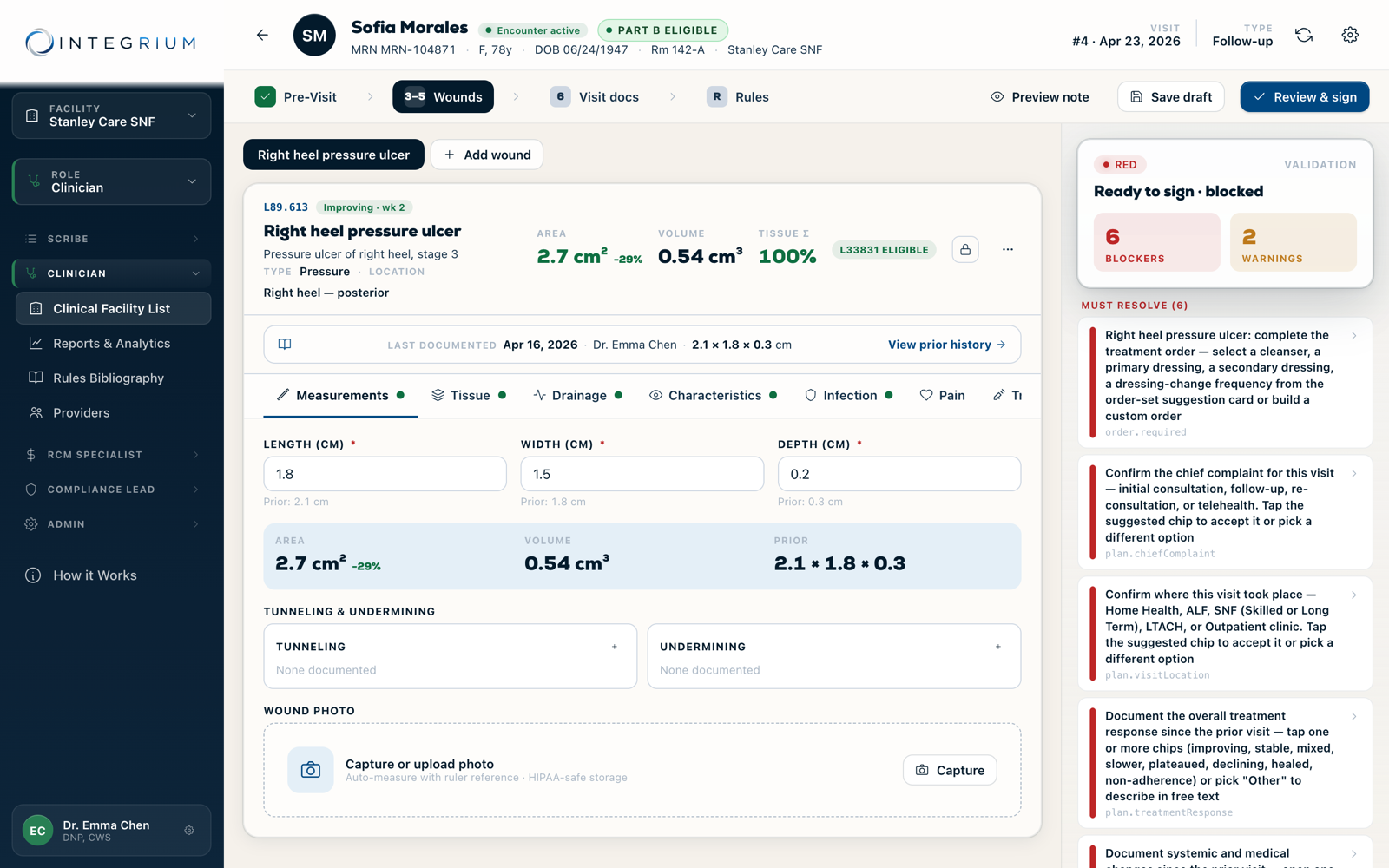
Integrium CORE wound documentation screen showing structured measurements, ICD-10 code L89.613, and live validation panel
Billing Rules Engine

Deterministic rules, every decision auditable

Integrium CORE's billing rules engine runs deterministic rules covering CPT calculation, NCCI edit validation, LCD compliance, medical necessity checks, and pre-submission sign-and-lock validation. Every rule fires the same way every time. No probabilistic models, no unexplainable outputs.

The RuleTrace audit trail captures the full decision chain for every billing validation: which rules fired, what data was evaluated, and what the outcome was. When payers question a claim, you have a complete, timestamped record of every validation that occurred before submission.

  • NCCI edit pair validation and LCD compliance checks at point of care
  • Pre-submission sign-and-lock validation catches errors before claims go out
  • RuleTrace audit trail with full decision chain for every validation
  • State-specific payer rules (e.g., Ohio MCO SA modifier logic)
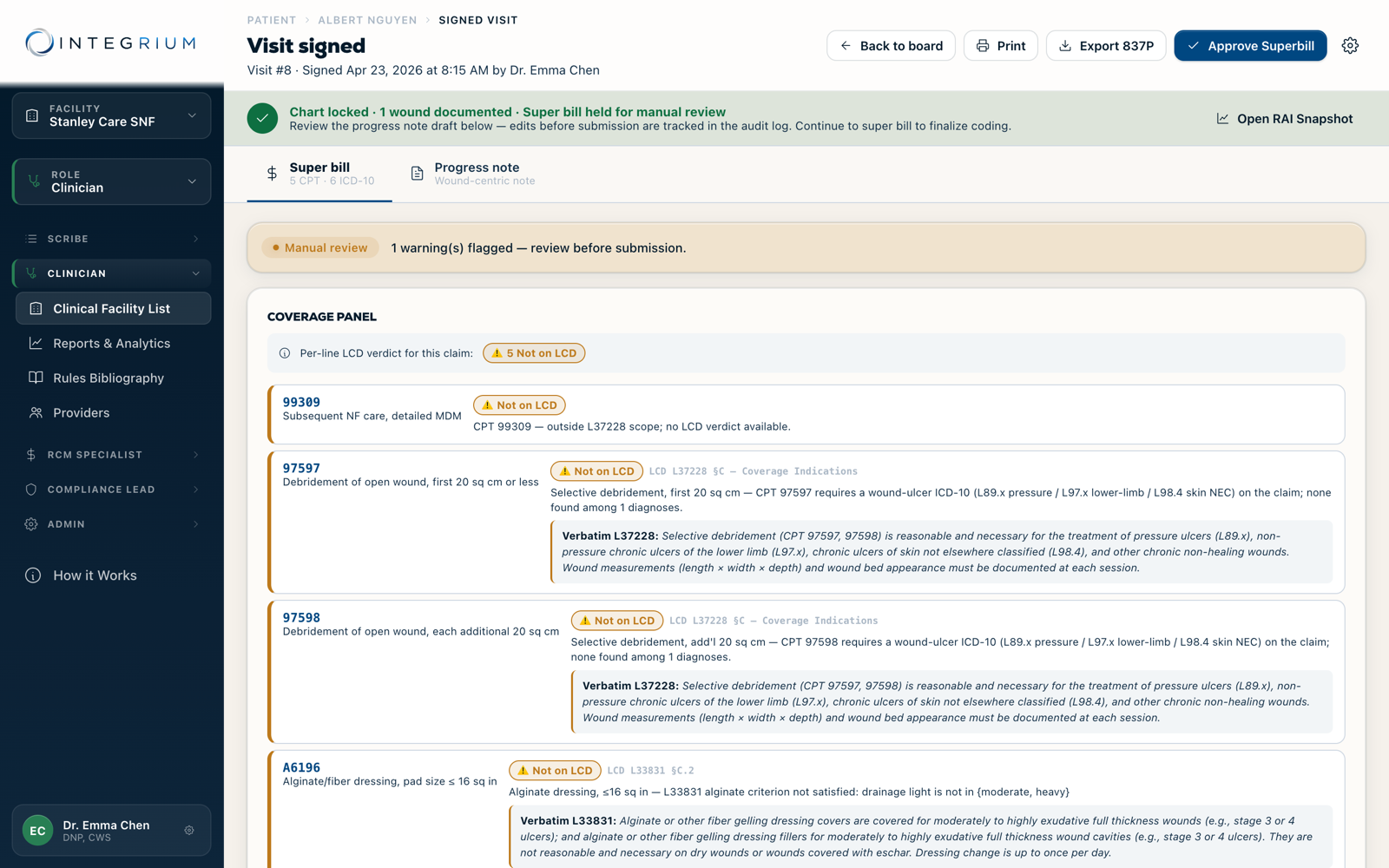
Integrium CORE super-bill review with per-line LCD coverage verdicts and verbatim policy citations for each CPT code
FHIR-Native Architecture

Built on Medplum, FHIR R4 from the ground up

Integrium CORE is built natively on Medplum's FHIR R4 platform, not retrofitted with a FHIR facade. Five purpose-built profiles (WoundCondition, WoundObservationPanel, WoundProcedure, Encounter, and Claim) model the full wound care lifecycle from assessment through billing, aligned with the HL7 wound assessment implementation guide.

Native FHIR means interoperability is built in, not bolted on. Clinical data flows directly into billing workflows through structured resources, and the CMS quarterly refresh pipeline keeps NCCI edits, MPFS fee schedules, ICD-10 updates, and LCD policies current, with SHA-256 integrity verification, dry-run validation, and audit logging on every cycle.

  • 5 FHIR R4 profiles purpose-built for wound care documentation and billing
  • CMS quarterly refresh with SHA-256 verification and dry-run validation
  • Native Medplum platform with no FHIR translation layer or middleware
  • A dual-reviewed scenario validation suite ensures data integrity across updates
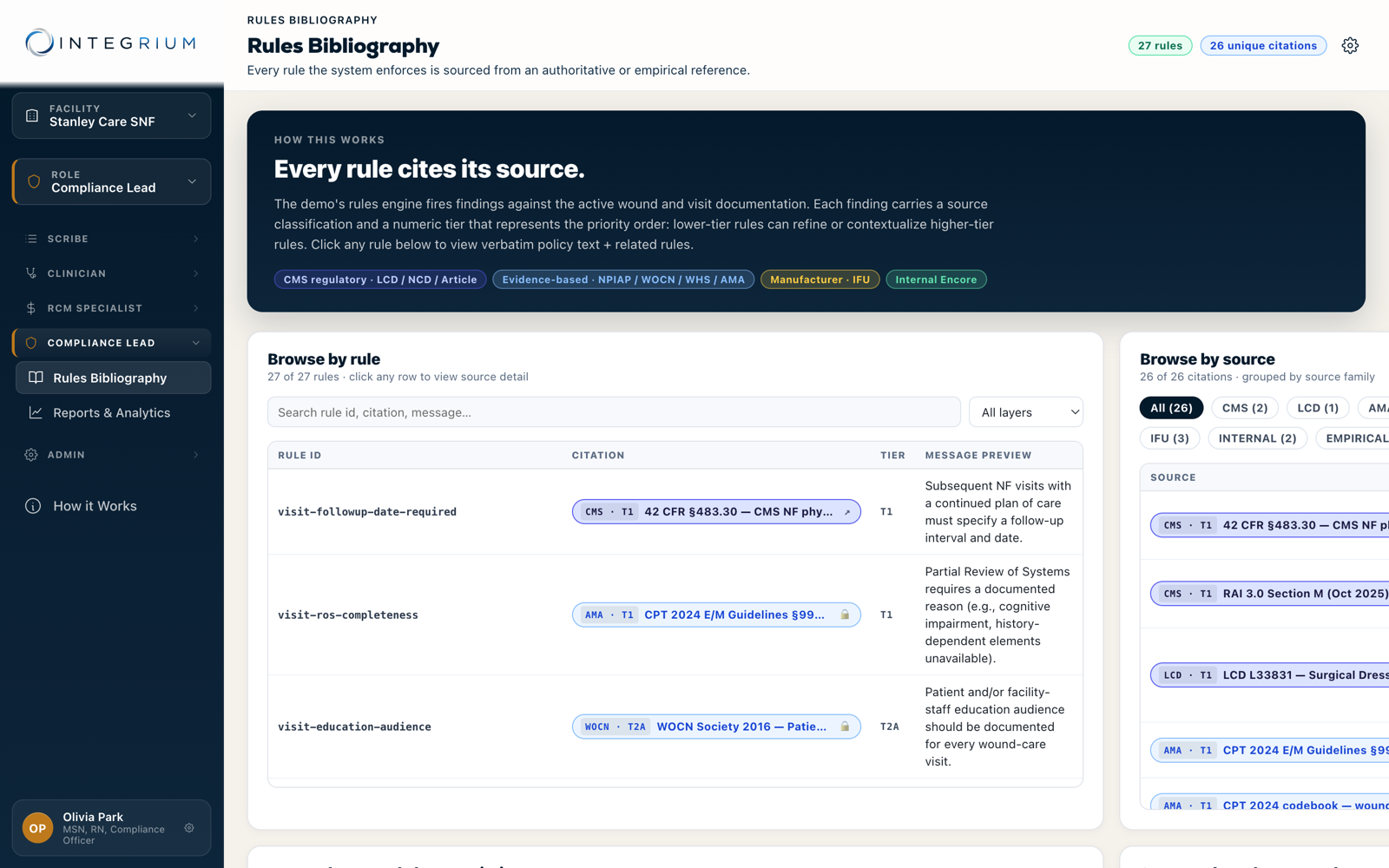
Integrium CORE rules bibliography where every enforced rule cites its authoritative CMS, LCD, AMA, or NPIAP source

Integrates With Your Clinical Systems

PointClickCare Migration Medicare/Medicaid Pharmacy Systems Lab Interfaces HIE Networks Surescripts
Built Different

Legacy EHR vs. Integrium CORE

Legacy systems lack wound-care-specific terminology, deterministic billing validation, and native FHIR architecture. Integrium CORE was purpose-built for wound care from day one.

Capability Legacy EHR Integrium CORE
Authoritative terminology (715K+ concepts)
SNOMED complex map evaluation
Deterministic billing rules with audit trail
FHIR R4 native data model
CMS quarterly auto-refresh
Pre-submission sign-and-lock validation
State-specific payer rules (e.g., Ohio MCO SA modifier)

See Integrium CORE in a live clinical demo

Walk through every capability with our clinical team and see exactly how Integrium CORE maps to your facility's workflows, compliance needs, and billing operations.